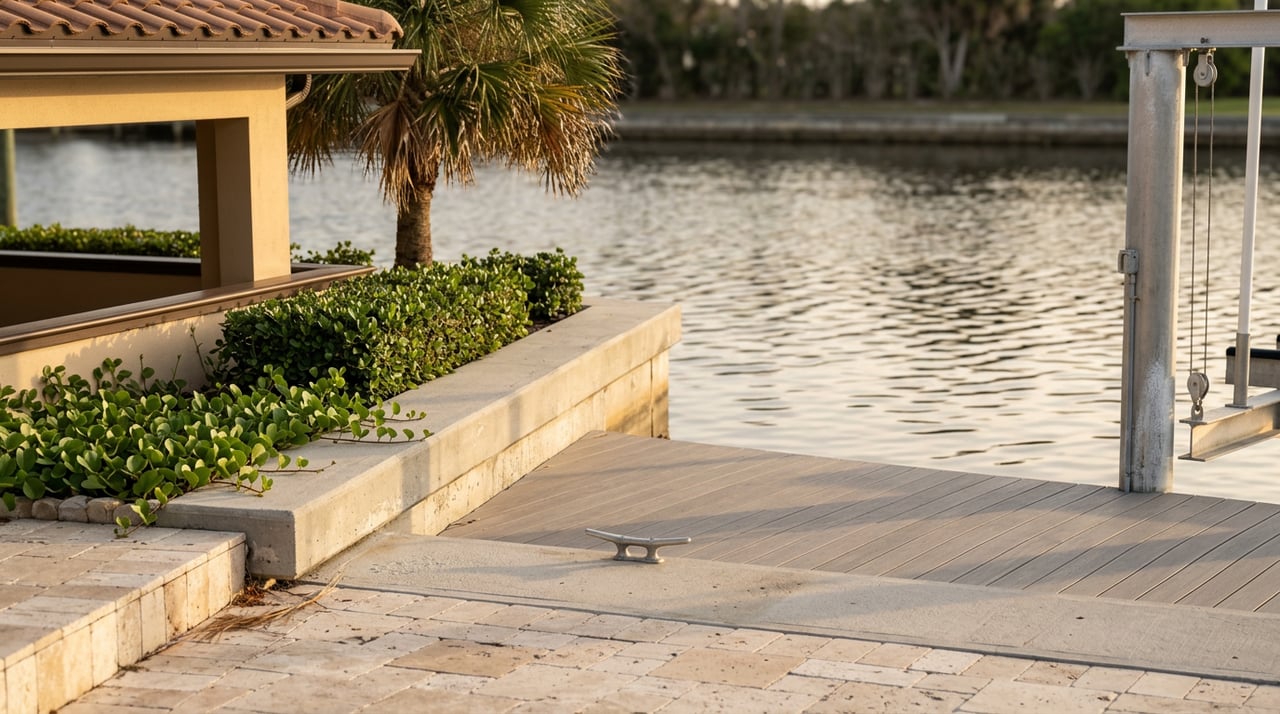
A canal-front seller in Punta Gorda Isles pulls the boat lift remote to prove it works before the first showing. It does. The seawall shows no visible cracking, the dock looks solid, and the listing photos come back clean. Three weeks into a contract, the buyer's lender asks for the final inspection record tied to that lift's wiring. There isn't one.
That is the version of this story that plays out more often than sellers expect, and it has almost nothing to do with how the property looks. In a canal community built around docks, seawalls, and boat access, the condition anyone can see is rarely what stalls a deal. The condition of the paperwork behind it is.
The rule most sellers have never read
Charlotte County's building department has a documented enforcement policy for dock, boatlift, and seawall permits that catches even conscientious owners off guard. If a permit for that kind of marine work includes any electrical component, wiring for a lift motor, a control panel, dock lighting, and no licensed electrical subcontractor was ever listed on the permit, or a separate electrical trade permit was never pulled, the work is treated as unpermitted. Full stop. The final inspection fails, regardless of how long the lift has been running or how well it works.
Punta Gorda Isles' canals fall under the City of Punta Gorda's own building department, which runs its own permit tracking system separate from the county's. But the underlying principle shows up across marine permitting in this part of Southwest Florida: a permit that covers the structure but not the wiring is not a complete permit. An owner who added a boat lift a decade ago and let a marine contractor handle everything, including the electrical, may be sitting on a file that looks finished but technically isn't.
The fix is simple and worth doing before a home ever hits the market. Pull the actual permit and inspection history for the dock, lift, and seawall, not just the assumption that "it was done right." A gap here surfaces during a buyer's due diligence far more often than it surfaces during a listing photo shoot.
Two canals, two ways to check
Because Punta Gorda Isles sits inside city limits, its dock design and placement rules run through the city's own code of ordinances rather than a blanket Charlotte County rule. The city also maintains roughly 45 miles of canals through a municipal canal program, funded through canal maintenance district assessments, and oversees dredging and seawall inspections directly. That is different from how a lot of Southwest Florida waterfront works, where county departments handle everything.
For a seller, the practical takeaway is narrow but important: know which department actually holds your permit file before you assume anything about its status. The City of Punta Gorda's building permits portal lets an owner track a permit from review through final inspection using the job address, and that is the first stop for confirming whether a seawall or dock permit closed out cleanly or is still sitting open.
What an appraiser actually wants to see
Canal-front appraisals in Punta Gorda Isles lean heavily on a handful of specifics that have nothing to do with square footage: sailboat versus powerboat water access, canal depth, and seawall structural condition. A buyer's appraisal moves faster, and lands closer to asking price, when the seller has already assembled the documentation that answers those questions instead of leaving the appraiser to dig for it.
That means pulling together, ahead of listing:
Document | What it proves | Where it lives |
|---|---|---|
Seawall inspection or replacement report | Structural condition backing up the listing description | City of Punta Gorda permit records |
Dock and boatlift permit with final inspection | Confirms the structure and wiring were both actually approved | City permit portal, or county if the parcel falls outside city limits |
Elevation certificate | Baseline for flood insurance quoting and lender review | Prior survey or transaction file |
Wind mitigation report | Documents storm-resistant features on the state's standard form | Licensed inspector, valid five years |
Four-point inspection | Confirms roof, electrical, plumbing, and HVAC condition for underwriting | Licensed inspector, typically valid about one year |
Two canal-specific data points matter more in Punta Gorda Isles than almost anywhere else on the West Coast of Florida: exit route and depth. Local boaters generally point to two ways out to Charlotte Harbor, Ponce de Leon and Alligator Creek through Buckley's Pass, and expect around six feet of water at mean low tide on the main routes, though depth varies canal to canal and dock to dock. Sailboat buyers in particular will also want to know actual bridge clearances, which the NOAA Coast Pilot documents for the fixed spans along the Peace River approaches, including the U.S. 41 bridges. A seller who can hand over a verified depth reading and a clear description of the exit route, rather than a vague "great boating access," gives a serious buyer one less reason to hesitate.
The insurance threshold that quietly moved in 2026
Most sellers in this market are still operating on an assumption that stopped being fully accurate sometime in the last year. For a long stretch, a four-point inspection, the one that checks roofing, electrical, plumbing, and HVAC, kicked in at the 20-year mark for nearly every carrier writing Florida homeowners policies. Enough of Punta Gorda Isles' canal-front housing stock sits past that mark that this threshold has shaped how sellers think about insurability for years.
That threshold has been loosening through 2026. Several carriers have pushed their four-point trigger back to 25 or 30 years, with 40 years now the age at which a four-point is almost universally required rather than the starting point. The conditions that still cause real trouble are specific and predictable: aging shingle roofs, Federal Pacific or Zinsco electrical panels, single-strand aluminum wiring, and polybutylene plumbing. A home that avoids those four issues is, in practice, an easier insurance conversation in 2026 than it was two years ago, even without a full remodel.
A wind mitigation inspection is worth doing regardless of age. It documents roof shape, roof-to-wall connections, and opening protection on the state's standard form, stays valid for five years, and commonly earns a discount in the range of 10 to 45 percent on the windstorm portion of a premium. For sellers with time before listing, the My Safe Florida Home grant program, reopened in August 2025, offers a two-to-one match, up to $10,000 in state funds against $5,000 of the homeowner's own money, for upgrades like impact windows, exterior doors, and roof-to-wall reinforcement. The catch is that a wind mitigation inspection has to happen first, to document the weakness the upgrade is fixing.
Why this matters more this year than it did two years ago
As of the first quarter of 2026, Charlotte County's active listings had climbed well past double their historical norm, pushing overall supply to roughly a 2.7-month pace, with Punta Gorda-area median prices for single-family homes and condos sitting between $355,000 and $399,000. That is a meaningfully more buyer-friendly market than the one that defined 2021 and 2022.
The connection to everything above is direct. In a tight seller's market, a buyer facing multiple competing offers is far more likely to overlook a missing permit record or an outdated wind mitigation report just to get the deal closed. In a market with 2.7 months of supply and real alternatives down the street, that same buyer, or more likely their lender, has both the leverage and the incentive to ask hard questions about paperwork that would have sailed through two years ago. Florida's documentary stamp tax, roughly $0.70 per $100 of the sale price, still applies regardless of market conditions, but the friction that actually threatens a closing in 2026 lives in the permit file, not the closing statement.
A few questions worth settling before you list
Does Punta Gorda Isles require a brand-new elevation certificate every time a home sells? No blanket rule forces a fresh certificate at every sale, but a lender financing a home in a flood zone will generally want one recent enough to reflect current base flood elevation data. An outdated certificate can slow a file even when the home's actual elevation hasn't changed.
Who do I call to check whether my seawall or dock permit is actually on file, the city or the county? Start with the City of Punta Gorda's building department. Punta Gorda Isles' canals and dock code fall under the city's own permitting system, and its online portal lets you search by job address.
If I have a boat lift I never touched and assumed was fine, could this rule still apply to me? Yes. The enforcement policy targets permits where electrical work exists without a listed electrical subcontractor, regardless of when the work happened. A lift installed a decade ago by a marine contractor who handled the wiring without a separate electrical permit can still be flagged as unpermitted today.
Selling a canal-front home in Punta Gorda Isles comes down to documentation as much as it comes down to price. If you want a clear read on what your specific permit and insurance file actually shows before you list, Chadwick Knight offers a free home valuation and market consultation built around exactly this kind of local detail.